
- Availability: Нету в наличии
- Product Code: 1
- Product overview
- Reviews (0)
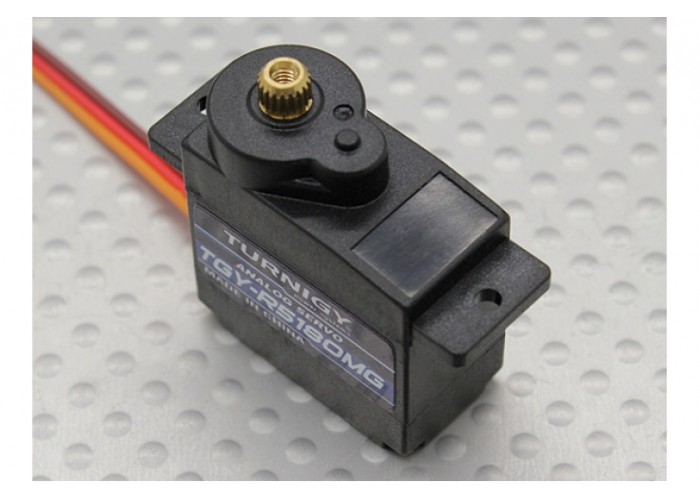
The Turnigy 180° Metal Gear Analog Micro Servo is a high-torque, durable actuator platform explicitly engineered for precision spatial positioning, camera gimbal stabilization systems, structural mechanical drop releases, and multi-role FPV payload infrastructure. Utilizing a ruggedized all-metal gear train layout enclosed within an ultra-lightweight 12-gram micro casing, this analog servo delivers active shaft position holding with an expanded 180-degree articulation matrix. Compatible with standard JR and Futaba pulse-width modulation (PWM) protocols, it balances rapid transit speeds up to 0.10 sec/60° with a robust 2 kg/cm torque ceiling, making it an ideal choice for compact airframes demanding reliable mechanical reliability under flight stress.
Features
Expanded 180° Positional Matrix: Unlocks a wide 180-degree rotation envelope with active structural shaft holding, providing a wide field of movement for pan-and-tilt camera tracking or mechanical linkage deployment.
Heavy-Duty All-Metal Gear Train: Features precision-cut internal metal gears that resist structural shearing, stripping, and gear tooth fatigue during high-impact landings or abrupt payload weight shifts.
Optimized Micro Power-to-Weight Ratio: Packs a punchy 2 kg/cm torque threshold into a compact 22mm × 12mm × 21mm footprint, allowing deployment on tight airframe frames without throwing off the aircraft's center of gravity.
High-Speed Low-Latency Tracking: Delivers rapid transit velocities down to 0.10 seconds per 60 degrees under a 6.0V load, enabling fast, real-time corrections for aerial filming stability.
Universal JR/Futaba Wiring Interface: Pre-wired with a flexible 180mm servo lead terminated in a standardized universal connector block, ensuring plug-and-play compatibility with standard receivers, flight controllers, and bench test modules.
Specifications
Brand: Turnigy
Model Name: 180-Degree High-Torque Metal Gear Analog Micro Servo
Actuator Classification: Analog Micro Servo with Active Positional Holding
Mechanical Rotation Limits: 180° Total Articulation Vector
Internal Gear Train Material: Heavy-Duty Precision Metal Alloys
Rotational Drive Bearings: Bushing Setup / Non-Bearing Layout Matrix
Primary Control Interface: Universal JR / Futaba Standard 3-Pin Connector
Integrated Lead Wire Length: 180 mm High-Flexibility Servo Ribbon
Physical Component Footprint: 22.0 mm × 12.0 mm × 21.0 mm (Micro Footprint Standard)
Physical Structural Net Mass: 12.0 g (Complete Actuator Housing Assembly)
Performance Matrices
Stall Torque Output Ceiling (@ DC 6.0 V): 2.0 kg/cm
Dynamic Transit Velocity Rate (@ DC 4.8 V): 0.12 sec / 60°
Dynamic Transit Velocity Rate (@ DC 6.0 V): 0.10 sec / 60°
Safe Input Voltage Operating Window: DC 4.8 V – 6.0 V Regulated Input Rail
Operational Instructions
Mechanical Mounting Layout: Position the micro servo inside your drone frame's dedicated camera gimbal dock, drop-release bay, or structural cutout. Secure the casing using non-conductive mounting screws, adding soft rubber grommets if needed to isolate the actuator from high-frequency motor vibration ripples.
Servo Horn Arm Calibration: Before attaching your mechanical control linkages, plug the servo into a standalone bench tester or powered receiver. Command the signal line to its absolute neutral position (1500 microseconds) to home the shaft, then press the plastic or metal servo horn splines onto the output gear at your desired starting angle.
Signal Harness Wiring Mapping: Route the 180mm connection lead away from spinning props and high-temperature video transmitter surfaces. Connect the universal JR/Futaba block to your receiver or flight controller PWM output rail, ensuring correct pin alignment: Brown/Black wire to Ground (GND), Red wire to Positive Power (+5V/+6V rail), and Orange/Yellow wire to the Signal (S) pad.
Linkage Travel Testing: Use your radio transmitter or bench tester to run a manual sweep loop across the entire 180-degree pathway. Verify that the mechanical arms, pushrods, or camera platforms do not strike structural frame plates at the maximum endpoints to prevent physical binding or current spikes.